If you somehow found this page, you should know that my blog is no longer being updated… for now, at least! I’m out of the habit of posting here, but I don’t want to delete my old posts because I quite like this record of my early days of taking my writing seriously and working on my novel. These days, the best way to keep up with my news is to follow me on Instagram or Facebook. You can also subscribe to my occasional newsletter on my site’s “Contact me” page. Thanks!
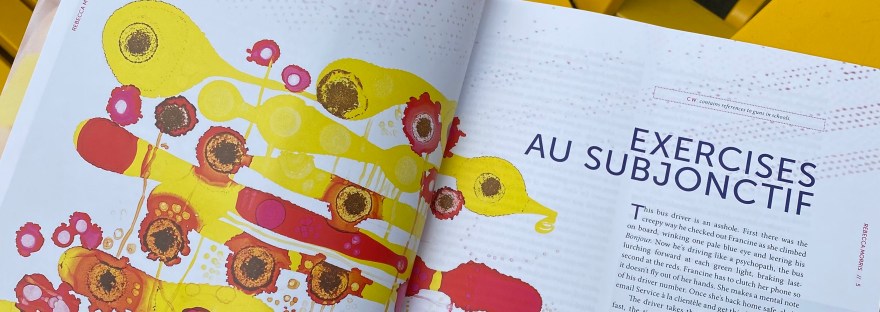
Here’s some good news: my story “Exercises au subjonctif” recently won the Humber Literary Review‘s Emerging Fiction Writers Contest! I just received my print copy of the magazine last week, but the whole issue is currently free to read online.
I’m obviously delighted with this win, and it’s a thrill to read the comments from judge Zoe Whittall; she praises my “clear, beautiful writing” and says the story has “a strong arc and point-of-view.” It’s a little surreal to receive accolades (and prize money!) when so many of my submissions still end in rejection.
It’s especially great to have the contest win on my CV as I query agents and Canadian publishers for my first novel and my collection of interlinked short stories. That’s right, I’m shopping around TWO manuscripts! After I finished my weird Covid novella back in January, I realized I’d written enough short fiction to put together a book. I’m calling it “We Don’t Throw Rocks,” after a line in “Urban Wildlife,” a story that was published online in Carte Blanche.
I’m also working on a new novel. So far I’ve written about 40 000 words but this is only the first draft and there’s a long way to go. I’ve gone back to writing first thing in the morning, which gives me the advantage of a quiet, distraction-free house while my kids are asleep. I’m writing longhand, then transcribing my work into Scrivener, my favourite word-processing app. (Do we call it an app if it’s on the computer? And does anyone say “word processing” anymore? Gosh, I feel old.) Anyway, I’m writing a lot, which always makes me happy.
I’m trying something new these days, working on a project that’s much shorter than a novel but much longer than a short story: a novella. Sounds cute, doesn’t it?
A novella typically clocks in between 10 000 – 20 000 words. This particular novella keeps surprising me, both in form and content. I thought I was writing a short story (under 5000 words) back in the spring, but the ideas kept expanding, spinning out, forcing me to give them space. Not only is this the first new project I’ve started since the pandemic hit, it’s also set in 2020. Maybe that’s why it’s so weird. I keep veering into dreamlike magic realism, which is a huge change from anything else I’ve written.
(In case you’re wondering: yes, I finally finished my novel back at the end of September! I’m now onto the stage of sending queries out to agents, with the hopes of finding someone who believes in my book as much as I do and wants to find me a kick-ass publishing deal. Fingers are crossed!)
I’m working on a first draft of the novella now, trying to get this finished before the December holidays. In the new year, I’ll take a step back and attempt to figure out what the heck is going on with this rough beast of a project (Character arcs? Themes? Whatever’s going on with the supernatural mountain lion school mascot that’s haunting my narrative?)… After all the nit-picky novel polishing of the past few months/years, I’m really enjoying the breakneck craziness of drafting something new.
Oh, and one more fun thing: I’ve created a Spotify playlist for the novella’s two main characters, teenage sisters who have very different taste in music. You’re welcome to check it out!
I’m about to finish my novel. Another day or two of edits on the final chapter, and my 90 000-word literary baby will be done.
It doesn’t quite feel real. I’ve been working on this book since at least 2011, back when I was teaching high school full-time, raising three little kids. I used to wake up at 5:45 every morning, to write before work. Now writing is my day job and my kids are all bigger than me! Time has certainly passed, and the Covid pandemic has made everything harder, but still I find myself here, at the finish line, at last.
Once I press “save” on that final draft, there are a few more steps before I can fully relax. I’ve written this book in Scrivener, so I’ll need to paste the whole document into Word — this entails another reread to make sure the formatting doesn’t go wonky. After that, I’ll take a couple of days to write the dreaded synopsis: a 1-2 page summary of the novel, showing the full story arcs and all key details. I’ve found lots of online guides and examples for writing synopses, so hopefully this won’t be as difficult as I anticipate.
Finally, by Friday, Oct. 8th at the very latest, I’ll send my manuscript and synopsis to a literary agent. And that will be it! Hard as it is for me to believe, I’ve actually written a book.
I’ve decided that writing a novel is a lot like knitting a fair-isle sweater.
How so? Well, sweaters are complicated. There are the design decisions: colours, type of yarn, size of needles, stitch patterns. There’s the painstaking work of actual knitting: stitch by stitch, sleeves and hems and panels, all eventually sewn together to make a finished garment. Then there’s the super complicated knitting pattern to follow (which I would never attempt to create myself! These are the domain of professional designers.)
Writing a novel is just as complicated. There are so many decisions that build on each other, a structure that needs figuring out, the long process of putting words and sentences and scenes and chapters together. Not to mention writing multiple drafts, which feels like ripping back knitting work and redoing everything differently.
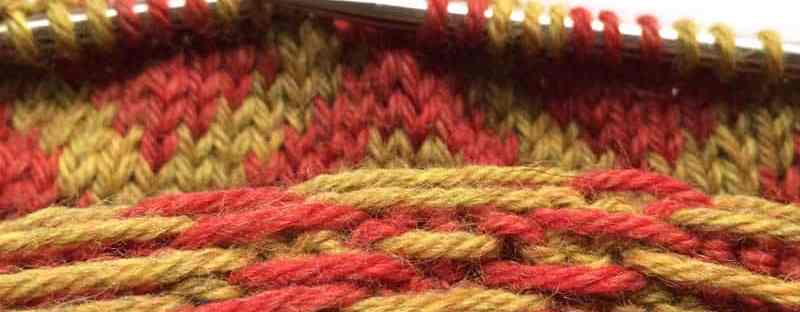
Let me push the metaphor a little further. If you’ve ever knit (or owned) a fair-isle sweater, you’ve probably noticed the ugly, messy reverse to the neat colourwork design. While you’re knitting, you carry strands of different-coloured yarn along the back, carefully maintaining an even tension so the stitches won’t be distorted on the front of the sweater.
This process of carrying yarn (technically called “floats”) feels like my writing these days, as I work through the final revisions of my novel. I have two main characters, lots of secondary characters and various subplots… there are lots of details to track though each chapter!
I’ve heard that it’s a good idea to focus each round of revisions on a different aspect of the novel: settings, maybe. Or psychological realism for a specific character. Then, as these major elements get worked out, you can go through the draft and cut unnecessary scenes, polish the language, and build up imagery and symbolism.
I’m going for a more immersive approach, working chapter by chapter, revising all of the above. I’ve just finished chapter 20 (out of 28), carefully balancing plots and characters and emotions to keep the tension steadily rising through the book. I’m trying to keep the threads taut so that the story’s got momentum, so that none of my messy edits show through on the final draft.
The colourwork baby sweater I knit for my nephew James this winter.



 Rebecca Morris