Tools of the trade

I love pens.

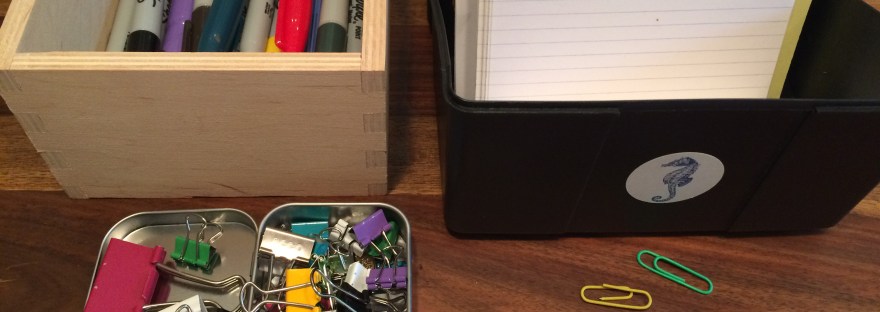
I love Post-its and Sharpies and notebooks and paper clips.

It’s not quite an addiction; let’s call it an appreciation. I love the smooth flow of ink from my fountain pen and the tiny giddy rush when I use the special corrector pen to change something I’d written in erasable ink. There’s the satisfaction of colour-coding my work with highlighters or the gratification of corralling my piles of index cards with binder clips. There’s the quiet thrill of cracking open a brand-new notebook and smoothing down the glossy paper, inhaling the faint chemical fragrance of glue as I lean in to inscribe words on the faint virgin page.

Heady stuff, right?

I have been known to make the occasional pilgrimmage to stationary stores in other countries, picking up cheap Waterman fountain pens in France or stocking up on Muji products at MOMA in NYC. If supplies are running low and there’s no trip planned, I can always rely on eBay. I’m not a big shopper, but I can easily lose an hour browsing in a decent papeterie, filling a basket with various writing implements and adorable desk accessories.

You may be shaking your head; you may be dubious or baffled by my fascination with the tools of my trade. Or maybe you’re nodding in secret understanding. Maybe you’re a stationary appreciator, just like me.

 

Taking the long view

It turns out I’m not a patient person.

I know, right? Shocking. You’d think that motherhood and teaching and 40 years of living on this planet would have taught me patience.

I know that writing a novel takes a long time. I mean, duh. People ask me “when I expect to be done?” and I smile, shivering inside. I’ve been working on this novel for so many years that it sometimes feels like I’ll never be done, that I’ll keep writing and changing and deleting and writing some more, forever and ever.

Writing is amazing and revelatory and challenging and meaningful, but it’s nice to actually finish something!

The truth is, I’m a long way from the finish line. I’m working hard on my scene-by-scene outline but I’m coming up against some hard truths about the road ahead and the amount of work that’s still to be done.

During last week’s virtual “office hours” for my online course, one of the writing instructors casually mentioned that “an author might take two or three months to finish an outline.”
Well, the top of my head just about blew off.
Two months?
Just for an outline?!
I’ve been exasperated with myself for needing two weeks!
So yeah, another reminder that patience is required if I’m going to do this right. When will I be finished this book? I can’t answer that question yet. I can’t even say when I’ll be done this outline, but it’s fine. I’m learning to keep the long view in mind.

Scene selection

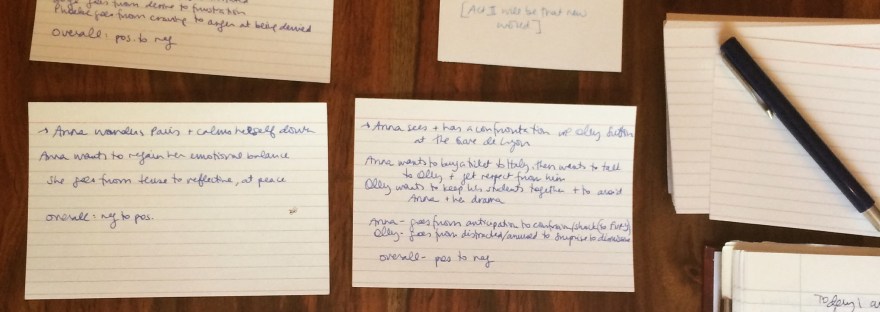
It’s happening. I’m doing it. I’ve got a fresh pack of index cards and I’m filling them in, one scene per card. I already know a lot about what’s going to happen in my novel, but I don’t know everything. That’s apparently about to change.

This week’s assignment for my online creative writing course is to map out the middle of the novel, scene by scene by scene. This means a whole bunch of decisions to make, especially since I’ve got two main characters who both have stories to tell. I can’t get away with skipping plot points or fudging details; now is the time to nail down my plot. Every single scene needs to contribute to the overall story and propel the narrative forward.

This is a big challenge because there are so many threads to track! I’m sorting out character development and conflicts, ups and downs and complications. I have to keep the whole story in mind but break it up into manageable scenes.

Once I’ve created a card for every scene I can think of, I’m going to lay them all out across my dining room table and put them in order. Then I should be able to see what’s missing and fill in the blanks with more scene cards.

This whole process is tiring and exciting and overwhelming and powerful. I’ve been working at this project for years but this is the first time I’m laying out all my pieces in such an organized, definitive way. Once this process is done, I should be able to go back to my drafts and see exactly what to keep, what to add and how to stitch it all together.

Then I just have to write the damn book.

Backwards design

I’m working backwards these days.

Normally, I figure out what I want to write about, then I jump in and draft a bunch of scenes. This book has been such a long-term project that I’ve produced hundreds of pages and many versions of some scenes. There are whole subplots that I’ve written and abandoned, entire characters who’ve emerged or disappeared in different drafts.

Anyway, now I’m trying a different approach to this whole novel-writing project. I’m making a plan, stripping my story down to its skeleton and checking that the head bone connects to the neck bone, the neck bone connects to the back bone and so on, all the way down to the toes. (And now I’ve got that song in my head. Thanks, brain.)

Backwards design” is an educational term that kind of describes this process. Basically, backwards design means that you first decide what you want students to learn, then you figure out how they will show this learning, and lastly you plan out your lessons.

I feel like I’m doing the same thing with my book; I’m going back to basics, figuring out my characters’ internal and external journeys and making sure there’s a logical progression from beginning to end. My online course is making me create a stripped-down scene-by-scene outline for my novel, so I’ve dug out some index cards and I’m doing some very disciplined analysis of the scenes I need to include.

I’ve just started this process, but already I can see that there will be scenes that I’ve already written that need to be expanded so that they serve more of a purpose in getting characters from one point to the next. On the other hand (gulp), some of the scenes I’ve written have got to go; some of the chapters that I’ve rewritten and revised and polished are not going to make the cut. I’ve got to kill some of my darlings, as Faulkner put it.

Scary stuff! But I should end up with a clear idea of exactly what scenes I need in order to tell my story, and I’ll be able to follow that outline like a roadmap. Here’s hoping, anyway.


Plotting

Let me start by saying that I have taught High School English. I have studied literature at university (in English and in French). I know all about plot elements. In fact, I could probably draw and label that classic pyramid-shaped plot diagram with my eyes closed.

And yet.

This week, my online writing course has me watching video lessons on the protagonist’s “journey” through a novel. It’s weird. I know this stuff backwards and sideways.

And yet.

I have always avoided applying my literary analysis skills to the book I’m trying to write. I worried about ending up with a predictable, cookie-cutter narrative: Inciting event. Rising action. Climax. Blah blah blah.

And yet – this is working for me. I’m doing character exercises to articulate the ways my two protagonists see the world at the beginning of the book vs. the end. I’m pulling back and thinking about the structure of my story and the pros and cons of keeping it linear. I wrote a synopsis with ALL the events I see happening, and all that information fit on one page, made sense and included elements of a beginning, middle and end: Inciting event. Rising action. Climax.

So maybe I don’t need to reinvent the wheel? Maybe I can take these characters, who have been haunting and inspiring me for so many years, and fit their stories into a logical framework. Maybe I can actually write this book.