Structural support

I’m a little stunned by my productivity this week.

I wrote more than 7500 words, propelling my total word count past 95 000. There are still a few chapters to go before this draft is finished, but I’m definitely on track to finish in June.

I’m sure it helps that I took that “break” to work on short stories last week, but the biggest factor of my success is the structure I’ve got in place for this book. My scene-by-scene outline lets me alternate smoothly between my two main characters, always moving their individual stories forward, juggling various narrative arcs and subplots.

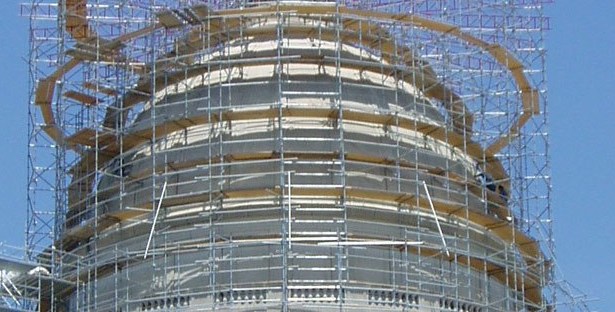
This doesn’t mean writing the book feels like paint-by-numbers, since I still have to work out the setting and action when I sit down to write each scene: the how and the where and sometimes the when. But the outline is providing the who and the why and the what next; it’s functioning as a scaffold for the whole book, stabilizing the overall structure and giving me the confidence that my story actually holds together.

The other major structural element that’s holding me steady is time management. My daily word-count goal and writing routine might seem constrictive, but they are habits that compel me to productivity. Sitting down at my desk at the same time every single morning keeps the book moving forward, day after day.
 

Short Story Week

This week I went rogue: no novel writing! I didn’t even open up the file in Scrivener.

Increasingly, over the past few weeks I’ve been struggling with motivation (not enough) and procrastination (too much), so I thought I’d change my focus for a few days and work on something different.

Instead of adding another 5000 words to my novel, I declared this ‘Short Story Week’ and gave myself five working days to work on shorter pieces. I revised a story I’d written a few months ago, changing details that didn’t fit and creating a whole new ending. I also started writing a new story, building up scenes and working out timelines and relationships for these new characters.

It was all very loose, freewheeling creative work compared to the structured writing I’ve been doing this year. I didn’t finish a polished draft of either story, but I made good progress and it was definitely satisfying to take a break from the novel for a few days.

To cap off the week, I gave a reading at the Atwater Library. I got to stand up and read my short story “Foreign Bodies” to a room full of attentive listeners. Pretty dreamy, especially being in the company of award-winning writers Laura Legge, Lesley Trites and Anna Leventhal.

Next week, I’ll be back to my regular routine: just me, typing away at my laptop, following my outline until I finish this draft.


Peer support

About once a month, I meet up with a writer friend to talk about our works-in-progess.

Carly and I met at a short story workshop run by the Quebec Writer’s Federation. She is younger than me but has already published a number of pieces, both fiction and CNF (creative non-fiction). She just completed her MFA and is now working on a full second draft of her novel.

In short, we have a lot in common.

Every few weeks, Carly and I get together at a cafe to talk shop. Over coffee, we commiserate about the difficulties of the writing life and cheer each other on when one of us feels daunted or overwhelmed. We talk about technical issues like narrative structure and point of view, and we share news of local writing events. We celebrate each other’s achievements and hold each other accountable for the goals we set.

Writing a novel is a long, laborious, lonely venture. I have lots of support from family and friends, but I am lucky to have found a colleague and friend who really gets it, who is wrestling with all the same challenges and pursuing the same dreams as me.

We got together today, and as always, it was both cathartic and encouraging. Every time we meet it boosts my spirits and gets me through the next few weeks of solitary writing work. Thanks, Carly!


Tracking numbers

I’ve been sitting down every day with the same writing goal: 1000 words.

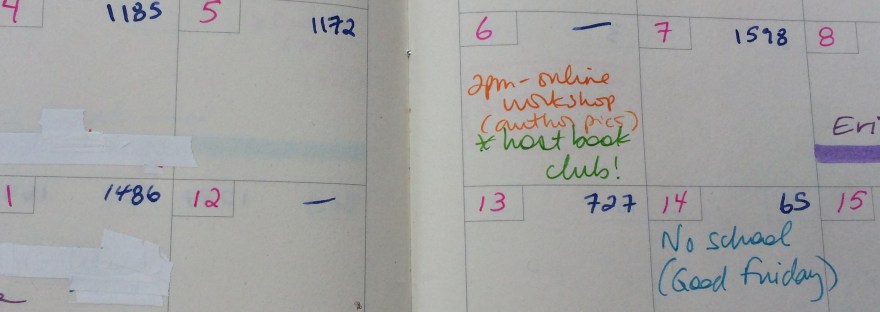
This has worked out pretty well, as you can see from this glimpse of my calendar. I record my actual word count at the end of every writing session, and you can see where I struggled and where I faltered, but also where I succeeded or surpassed my goal. It’s immensely motivating to look back and see the steady progress I’ve been making since December, but this week I decided to step things up and set a new goal:

1200 words a day.

Today I was done by lunchtime. Yesterday it was nearly 2pm before I’d finished, but I got it done. There’s a funny thing about increasing my word count goal: it makes me write faster, plunging ahead and tackling scenes that I’ve been anticipating with anxiety. My number one priority is getting the pages written, not getting hung up on perfection.

Knowing that I’m moving faster towards the end of this draft is also helping me to increase the momentum of my scenes; I’m spending less time on description and dialogue and focusing more on action. This is shortening my scenes but also propelling me forward, along with the story.

All good news, right? Hopefully I can sustain (or even increase!) this new pace over the remaining weeks it’ll take to finish this draft of the book.


Losing the plot


Things are getting tricky.

There’s no denying I’ve reached the dreaded “saggy middle” of this novel. This is the section that seems to meander aimlessly, sapping the energy out of the whole story.

I’ve been here before, in previous drafts of this project. It’s always so exciting to start writing, so much fun to create characters and plots, to wind them up and set them spinning. At a certain point, though, the action slows down. Logistics get complicated, confusing. After 50 or 100 pages, the writer runs out of steam: this is the “saggy middle.”

So here I am. I had really, truly hoped that following my meticulously-plotted, scene-by-scene outline was going to prevent this problem. I thought all my cunning little subplots were going to keep the momentum going in this manuscript, that I’d skip happily along my well-marked narrative trail, from rising action all the way to the climax.

And you know, without my outline I might be giving up at this point.

But not this time; I’m too stubborn. I planned this thing and I’m going to see it through. I may be gritting my teeth and racing through some of these scenes, but I’m not skipping anything. Yes, it’s painful to write a scene while my inner critic is yammering away, insisting that these pages will be the first to be cut when I get to my next draft.

But there can’t be a next draft until this one’s done. So I persevere.